Father for a year
- Posted: 2025-11-16
- 9 min
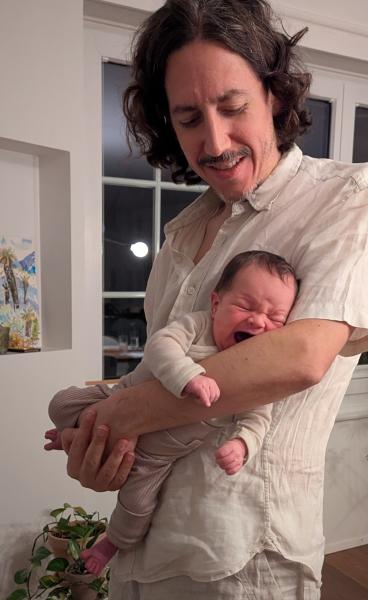
I became a father one year ago. It’s been a blur of joy, exhaustion and profound learning. I wanted to take some time to write down my main conclusions.
☙
Show your excitement. Something happens and you feel excited? Talk about it! Celebrate it! Scream! Dance!
Excitement is contagious and has positive feedback loops. When I verbalize moderate excitement, my son gets excited; and when he gets excited and shrills, my excitement grows.
How amazing, a tram has arrived!
☙
You can only be in a good mood when your body is well.
Is he tired? Hungry? In pain? Sick? Too hot? Too cold? He’ll be upset.
Teething is painful. All those 20 milk teeth have to push through, mostly one-by-one (sometimes they come in pairs). As this happens, he’s irritable for a few days. Calming gel brings relief.
☙
Put your oxygen mask on first.
If you are tired, hungry, in pain… you won’t be at your best. You’ll get frustrated more easily.
☙
Mothermilk and breastfeeding are essentially a miracle. I was not aware of how complex this is. Mothers produce an incredibly nutritious substance, containing many antibodies, the baby’s primary (and, in many cases, only) sustenance for months. The process of breastfeeding strengthens the emotional connection between baby and mother.
It’s OK (with some caveats) for exclusively-breast-fed babies to not poop for up to two weeks! Mothermilk is that efficient.
☙
Sleep is difficult and important. My son is often tired but wants to stay up and play. He doesn’t understand how important sleep is. He just wants to explore the world.
I am often tired but want to stay up and program.
☙
Great events often cause inconveniences. Don’t let the latter annoy you and take away from the joy of the former.
As his personality develops, he begins to form his own opinions and wants.
He starts refusing to eat just because he doesn’t feel like it. Insisting, even if he has barely had any food, achieves little.
Sleeping becomes difficult.
☙
This is a crash course in logical fallacies. He makes questionable choices as he learns to navigate reality:
Short-term thinking
Getting frustrated easily and overreacting
Targeting the instance of the frustration rather than addressing the root cause
☙
You also face similar tests, where you have to find the right balance between the short- and long-term.
Do you insist that he eats a bit more —so that he (and you all) will have a better night— or do you take him off the dining table as soon as he shows that he doesn’t want to eat anymore —to avoid negative associations with dining and (probably?) encourage better behaviors?
☙
Older parents compare him with their recollection of specific instances of their kids, many decades ago.
However, most of his traits (how social or shy he is; how well he sleeps at night; how well he accepts food; etc.) are in constant flux.
There seems to be a lot of negativity/availability bias, where difficult phases seem to be overemphasized, more easily remembered.
☙
The first three months are the toughest. Sleep when the baby sleeps.
I used checklists: one for the morning, noon, afternoon, and evening. They helped me stay on top of things.
Take all the help you can get. A friend offers to cook and bring you a meal? Someone buys bread and leaves it in your mailbox? Thank you! Thank you so much!
Do this for new parents. Take chores, no matter how mundane, from their plate.
☙
In the beginning, babies can barely see. Their sight develops gradually over the first few months. They find lamps fascinating. Their hearing, however, is perfect from the start (baring problems, of course).
☙
Change is constant. There are very clear shifts, phases. Many changes are unpredictable.
Some weeks he sleeps peacefully every night. Then he switches to wanting to play every day at 3 am. Then he goes back to sleeping well.
He used to love laying on the diaper-changing station. Now he hates it.
☙
People make a big deal out of changing diapers. It is nothing.
☙
Somewhat mundante, but your hands (skin) will suffer from all that hand-washing and picking up the baby. Buy a good lotion.
Your wrists may also suffer. Look up «mother’s wrist».
☙
In some ways, raising a baby is like playing a video game. Though the start is very demanding, the visible variables in the system are few. The baby mostly just suckles, cries, sleeps, and shits.
As you start mastering these things —as you level up— the system changes drastically —new variables appear. You have to keep adjusting. Never a dull moment.
☙
À propos pedestrian analogies, watching many movies about a place doesn’t compare with the experience of actually visiting it. The difference between knowing how something will unfold and experiencing it is huge.
Even had I not been surprised nor learned anything new, the gap between understanding intellectually and experiencing emotionally would have been just as large.
I wrote a poem trying to express this.
☙
A cliché question in team-building questionnaires: “What are you afraid of?” I never knew what to answer. I’m afraid of neither spiders nor heights… At best I effused platitudes: “loneliness.”
Now I know: I never found anything as scary as the possibility, however remote, of your baby being unhealthy.
☙
The baby will disobey you: he’ll go grab the plant’s leaves, tug on the thing he shouldn’t, punch you, scratch you.
You will feel anger. Remind yourself: babies lack the capacity for self-control and the best course of action is to react as boringly/neutrally as possible (and physically restrain the action, while redirecting his attention to something else).
☙
Babies fall. Especially as they start crawling or standing. They hit their head. Many times. No matter what.
The best place to put the baby is the floor, especially as they start to move (around the time they master tummy time). Concussions are worse than moderate dirt.
Pain is such a useful signal! Avoiding pain is a great motivation to improve.
☙
Lack of calibration makes things difficult.
Is our baby difficult (in whatever specific sense)? Is he very loud? Or rather quiet? Has he been crying too much? How worried should we be?
Not having a good reference makes it difficult to answer these questions.
☙
Although he can only say a few words, we’ve developed a rich protocol. It already includes humor: making one another laugh by playfully teasing each other or doing unexpected things.
In the beginning, the things he finds funny are very unpredictable. Eventually you reach the point where you can make him laugh somewhat consistently and he’s delighted when he can make you laugh.
It’s remarkable that someone who can’t yet speak can already understand that you’re deliberately doing something unexpected and laugh about it.
☙
Besides a few obvious properties (appearance, voice…), I think he distinguishes familiar individuals by a large number of subtle properties: the way we walk, the way we hold him, our smell, the texture of our clothes, etc..
☙
In the beginning (before ~10 months), most things he ate:
- He hated on 1st try.
- He accepted reluctantly on 2nd try.
- He ate willingly from 3rd try on.
However, his eating habits changed recently and feeding him became more complex.
☙
Many milestones focus on physical activities (grabbing objects, staying on his tummy, standing up, crawling, etc.). For me, “social” milestones have been far more meaningful. Of all milestones reached, the most meaningful were:
Showing unequivocally that he understands many words (around 10 months). He responds to questions such as “where is the bunny” or “how does the dog go?”.
Laughing at things he finds amusing (around 5 months old).
Smiling (around 5 weeks old).
Dancing and/or “singing”. Mostly when I play the harmonica, but also when he gets excited for a variety of reasons. He is quite musical.
Exploring his surroundings on his own, daring to briefly go alone into another room, leaving his parent behind.
☙
Raising a kid takes a lot of energy.
You’re so very sleep deprived and yet you’ll have to get up at 4 am to change his diapers and he’ll scream mad at you (and boy can he be so very loud!) and before you can put on his new diaper he will take a big, very liquid, unexpected shit which will spill everywhere and seep through the little wooden grill on the front of the changing station and he will continue to scream so very very loudly and… you’ll feel very frustrated.
☙
Raising a kid is absolutely worth it1.
You will find yourself sitting down on the kitchen floor eating lukewarm pasta out of a bowl surrounded by many plastic bottles and sheets of cardboard that he took out of the recycling bin to play with as you cooked. The laundry machine will start beeping –it’s time to go hang his diapers to dry– as he continues to dance against your wine rack, trying to topple it or at least fish out a bottle.
And you will feel very happy.
☙
Raising a kid is worth it.
One Saturday morning you will have the privilege of deciding that the time has come for this person to discover the wonderful concepts of red, yellow and blue for the first time in his life.
When he gets hurt or scared, he will rush to your arms for safety and protection. These simple events will give your life a lot of meaning.
You will closely guide a fellow human through a magical journey that starts with not understanding any words, barely able to see anything, and leads through such wonderful ideas as the beauty of nature, the warmth of a smile or a caress, etc.. You can make up anything you want (such as our very own gesture for butterflies or the sound that the toucan makes) and he’ll be observing you very seriously, taking it all in.
Related
- Up: Essays
- Interacting with toddlers: Advice for how to interact with toddlers, for non-parents.
For me. I don’t mean to tell anyone what to do!↩︎