Knitting: Mental health and growth
- Posted: 2026-05-28
- 6 min
Knitting teaches us to steady our minds.
☙
Knitting —the art of tangling very long threads into useful and unlikely shapes— offers personal lessons about learning and cognition.
I was writing why I find knitting great and quickly came to a realization: it’s mainly due to its connection to mental health and personal growth.
I have some ADHD traits. Though I’ve never been diagnosed and my symptoms are mild, the lessons from knitting have been valuable. Many of these lessons are somewhat obvious, but part of the value is that knitting makes them very palpable.
Progress as a knitter is gradual and tangible, with many opportunities to exercise important skills that transfer to many other areas. Managing large knitting projects requires maturity, discipline and perseverance.
☙
Knitting helps you improve your emotional regulation.
I found myself knitting at relaxing times but also when preoccupied with life’s normal stresses; when fully rested but also after long tiresome days; whether I’m fully focused on the yarn or actively listening during work meetings; on warm and sunny afternoons just as on gray and rainy mornings.
These different moods cause tension variations —fairly visible defects on the final garment. The tension of the yarn echoes the temperament of the knitter. To avoid these defects, I had to learn to look past life’s travails and steady my mind whenever I pick up needles and yarn.
☙
To improve as knitters, we must make room in our homes, schedules and minds for long-lasting projects.
Creating a large piece requires discipline and perseverance. Talk about delaying gratification: we must keep going for weeks or months, often without fully knowing how the final piece will turn out.
What do you do if your preferences (e.g., for the color or size) change as your work is underway? Do you continue with aplomb? Do you start afresh?
☙
Knitting teaches you acceptance.
When my son was born, I knit him a forest-green blanket. Unfortunately, tension problems made a few rows noticeably looser than the rest. It only affects parts of two or three rows out of about four hundred, but they stand out (especially near the top, in the middle of the 2nd group of garter ridges):
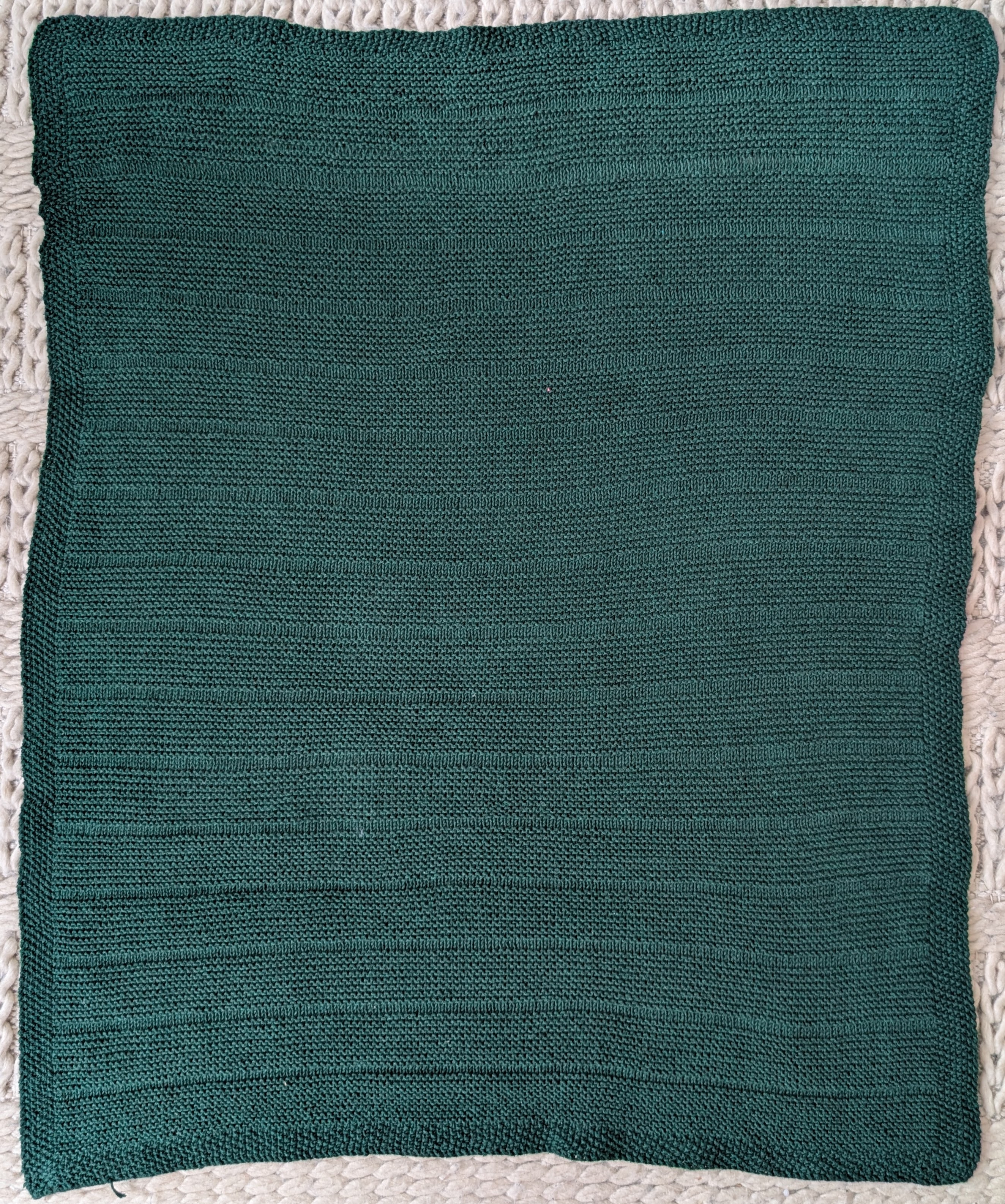
… and that’s okay! My son certainly couldn’t care less.
We want each piece —each stitch— to be perfect, but knitting offers us lessons about being forgiving and accepting the minor flaws in our knitwear that don’t affect the end result.
☙
Knitting reminds us to listen to our bodies’ early signs and to rest even when we’re obsessed with productivity.
Holding tension and repeating a movement for hours can hurt! As I was knitting one of my ruanas, my left wrist started hurting (likely flexor tendonitis, made worse by strength training). Good posture, self-awareness and breaks matter.
☙
Repeating a movement for hours can be very meditative. The physical sensation grounds you in the present, on the feeling of the yarn on your hands. You notice the large impact that different yarns can have on your enjoyment of the process.
The feeling is somewhat analogous to the pleasure of taking photos with mechanical cameras or to writing with a fountain pen on your favorite paper.
☙
By giving us opportunities to learn from failure, knitting is a great playground to reason about our own thinking.
New skills open up possibilities, making us more ambitious. Venture too far out, though, and failure inevitably follows.
Introspecting when mistakes happen helps us come up with approaches to avoid or ameliorate them. It also helps us calibrate intuitively how far to stretch out of our comfort zone.
Frequently shared advice: start with a swatch1. The thirty minutes it takes is nothing compared to the days (or months!) of large pieces. This is a simple reminder, among many others, of the importance of validating our assumptions.
☙
As we start designing our own knitting patterns (or tweaking existing patterns), we gain appreciation for the relative importance of each decision and the value of flexibility.
Sometimes we must commit in advance and mistakes can ruin the entire piece. My early headbands were invariably too loose (I wanted a headband but, oops, I got… a cowl!).
Good patterns, however, let us improvise as we go: stop knitting when the scarf reaches the desired length. The pattern is not only judged by the end result (when perfectly knit), but by how “adaptable” the pattern’s approach is: does it allow ongoing customization and improvisation?
Following various patterns and designing our own helps us experience the value of flexibility directly. This process shows how adjustments in our approach can enable us to operate with fewer upfront commitments, and the resulting malleability often effects better results.
☙
Good patterns are also pleasant to follow. Knitting helps us become aware of some of the million little things that make a journey more pleasant.
☙
Knitting invites you to reconsider your relationship with objects.
I mentioned mechanical cameras earlier; another connection I see to photography is that focusing intensely on an object —whether the motif you’re photographing or the piece you’re knitting— changes your relationship with it.
Is some object more valuable because you’ve invested a lot of time to create it? Or is that just sunk cost fallacy?
Is some object more valuable because it was gifted to you by someone dear? Is there such a thing as “emotional value”? Does the value change depending on the amount of time that the giver invested to create the object given?
The answers are, of course, very personal.
I find that knitting allows me to imbue objects with a history of their own. This may happen because you met the artisan who hand-spun and hand-dyed the special yarn you’re using; or maybe because you carefully designed the object (e.g., pattern, colors, yarn…) trying to express a particular feeling or atmosphere; or because you made the object for a specific person.
☙
I have knitted on and off for about three years. When I started, I didn’t expect the hobby to take root. I just wanted a simple challenge: knit a scarf and be done. But I still take my yarn and needles wherever I go and I appreciate how they help me still and understand my mind.
Related
- Up: Essays: Knitting
- Get started: Knit a dish rag, where I describe what I think is the best way to get started.
A swatch is a simple square used to measure the size of your stitches, allowing you to adjust your pattern and ensure that your final piece will have your target size.↩︎